The most practical way to remove hulls from bird seed at home is a two-step process: crack or break the hulls first (or buy pre-hulled seed), then separate the loose hull material from the kernels using a mesh screen or a gentle airflow (winnowing). For sunflower and safflower seeds, winnowing works especially well because the papery hulls are much lighter than the kernels. For small seeds like millet, buying pre-hulled is almost always easier than processing them yourself.
How to Remove Hulls From Bird Seed at Home
Maya Collins
22 May 2026
Why bother removing hulls in the first place
Hull removal comes down to three practical problems: mess, waste, and access. Hulls pile up under feeders and on trays, creating a soggy mat of dead shell material that holds moisture, grows mold, and can attract rats and other pests. Birds like finches, doves, and sparrows that swallow seed whole rather than cracking it can struggle or flat-out reject seeds that still have a tough outer shell. And when you buy seed by weight, a significant portion of what you paid for is inedible hull.
It matters most for sunflower and safflower. Black oil sunflower has thin shells that most songbirds crack easily, but the hulls still pile up. Safflower has a much thicker shell that smaller birds genuinely struggle to open, which is why cardinals dominate safflower feeders while smaller birds mostly ignore it. If you want softer-billed birds eating safflower, you need to remove those hulls. Millet hulls are tiny and harder to remove at home, which is why pre-hulled millet is the better buy if you want a clean, low-mess option.
Know your seed and what you're actually removing
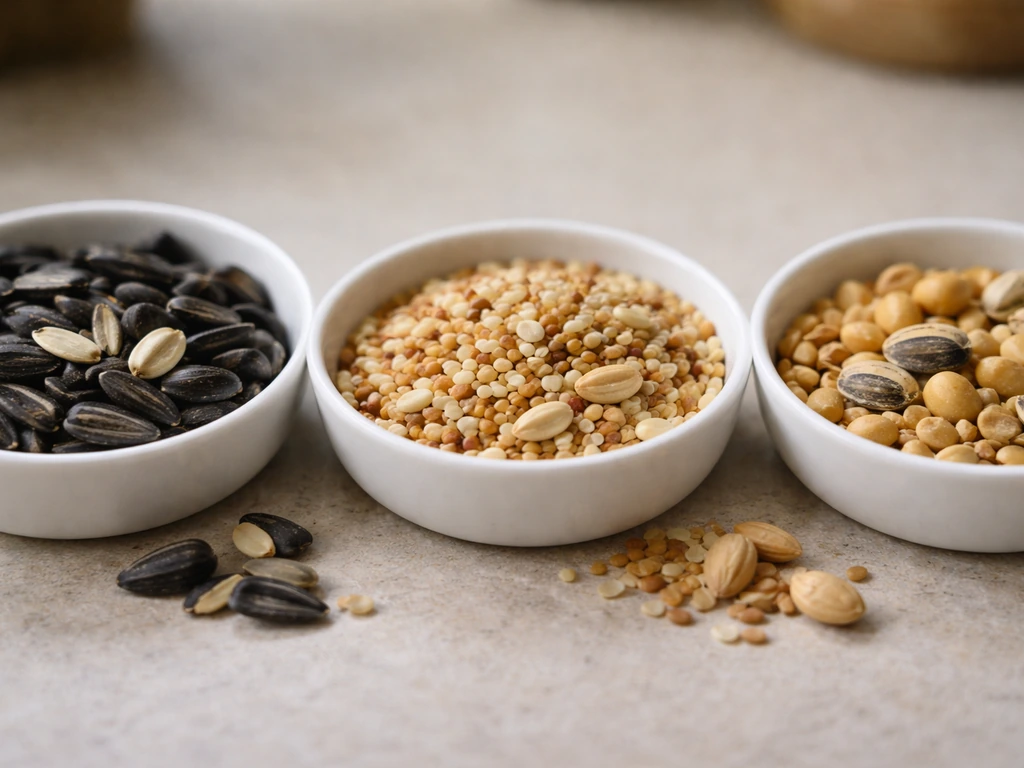
Before you start processing anything, it helps to know what a hull actually looks like on each seed type. The "hull" is the hard or papery outer shell (technically called an achene on safflower), and the kernel is the edible part inside. They differ noticeably in weight and thickness across seed types.
| Seed type | Hull description | Hull difficulty | Best removal method |
|---|---|---|---|
| Black oil sunflower | Thin black shell, splits easily | Low to moderate | Winnowing after cracking |
| Striped sunflower | Thick striped shell | Moderate to high | Winnowing after cracking |
| Safflower | Hard white shell (achene) | High | Buy pre-hulled or screen/winnow after processing |
| Proso millet | Thin papery hull, very small | Very high (tedious) | Buy pre-hulled hulled millet instead |
| Nyjer/thistle | Tiny seed, hull is minimal | Not practical to remove at home | Buy sterilized or hulled product |
Intact seed has a hull fully enclosing the kernel. Dehulled or hulled seed has had that outer layer removed, and the kernel may be whole or broken. When you're processing at home, you are working toward that "dehulled" state. If you're not sure whether you're looking at a hull or a damaged kernel, the hull piece is almost always lighter in color, papery or brittle in texture, and noticeably lighter in weight than the kernel.
Hand-sorting and screen separation
Hand-sorting: when it makes sense
Hand-sorting is slow but useful for small batches or when you want to pull out a specific contaminant (a few clumped or moldy seeds, a stray twig, etc.). Spread seed in a single layer on a white tray or sheet pan where you can see color and texture contrast. Hulls are typically paler, lighter, and flatter than whole seeds. For anything larger than a cup of seed, though, hand-sorting is not the right primary tool.
Screen and sieve separation
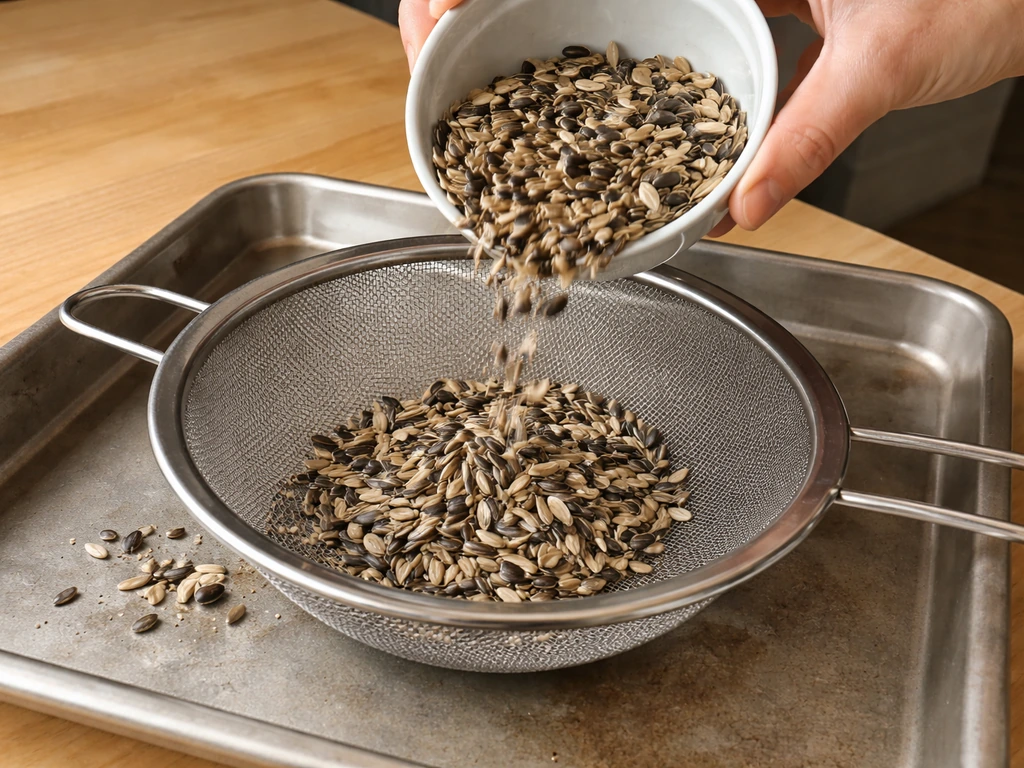
Screens work by exploiting the size and shape difference between kernels and loose hull pieces. After you've cracked or broken the hulls (by rolling a rolling pin gently over the seed, or running it through a small hand-cranked mill set to crack rather than grind), the loose hull fragments are typically flatter and more irregular in shape than the round or oval kernels. A metal mesh screen or hardware cloth with the right opening size lets kernels pass through while retaining larger hull fragments, or vice versa depending on your screen size.
- Lightly crack the hulls using a rolling pin on a flat surface, or pulse briefly in a hand-cranked grain mill. You want broken hulls, not crushed kernels.
- Pour the cracked seed onto a wire mesh screen or kitchen sieve. A 1/8-inch mesh (about 3mm) works well for sunflower; smaller mesh for safflower.
- Shake the screen gently over a catch tray. Kernels and small hull fragments fall through; larger hull pieces stay on top.
- Flip the approach if needed: use a coarser screen where kernels are retained and fine dust and debris fall through.
- Repeat with a second, finer screen if you need cleaner separation.
Hardware stores sell wire mesh in various gauges. For sunflower, a 1/8-inch (3mm) hardware cloth frame is a common DIY solution. For safflower kernels, which are a bit larger, a slightly coarser mesh works better. You can staple mesh to a simple wooden frame in about 10 minutes and have a reusable seed screen that outperforms any kitchen colander for this job.
Winnowing: using airflow to lift hulls away
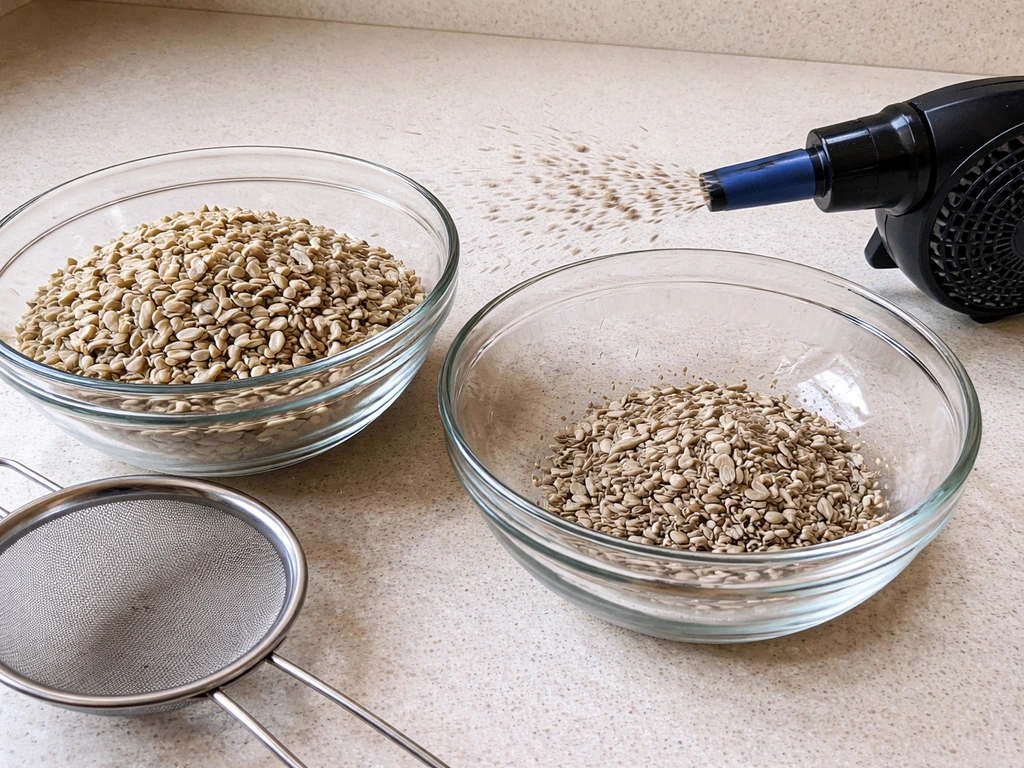
Winnowing is the most efficient home method for sunflower and safflower once the hulls are cracked loose. The principle is simple: hulls are much lighter than kernels, so a moderate airstream lifts and blows the hull pieces away while the heavier kernels drop back down. This has been used in grain processing for centuries and it works just as well in your backyard.
Basic outdoor winnowing
- Take your cracked seed outside on a calm or lightly breezy day. If there's no breeze, a box fan on a low setting works.
- Hold a container of seed at about chest height and slowly pour it into a wide catch container on the ground below.
- The heavier kernels fall straight down. The lighter hulls catch the air and drift sideways or blow away entirely.
- Repeat two or three times, moving the pour point a little higher each pass for cleaner separation.
- If using a fan, position it to blow across the falling stream, not directly into it, to avoid blowing kernels away too.
A shop vac on low blower mode (reversed to blow instead of suck) makes a controllable indoor-friendly air source. Point the exhaust across a falling stream of seed over a tarp. The mesh screen on a hand-operated winnower design is there to keep debris out of the blower intake, so if you improvise, make sure nothing can get sucked back into your vacuum. Work outdoors or in a garage with good ventilation since hull dust can irritate airways.
How clean does it need to be?
You rarely get 100% hull removal with a single winnowing pass at home. Two to three passes typically removes the bulk of the loose hull material. A few small hull fragments in the finished batch are harmless to birds and not worth obsessing over. Commercial dehulled seed goes through multiple sieve and density-separation stages, which is why it's so clean and also why it costs more.
Soaking and wet processing: proceed with caution
You'll sometimes see suggestions to soak seed to soften hulls before removal. This can work in very limited situations (making safflower hulls slightly easier to crack, for example), but the mold risk is real and serious. Any moisture introduced to bird seed creates a window for mold growth, and moldy seed is harmful to birds. If you soak seed, you need to use it immediately or spread it on a clean dry surface in a single layer and let it dry completely (ideally in sunlight) before storing or filling a feeder.
My honest recommendation: don't soak bird seed unless you have a specific reason and you're going to use it right away on a tray feeder. The time and mold risk aren't worth it when dry methods (screens and winnowing) work better and are safer. Wet seed sitting in a feeder or a closed container is one of the fastest routes to a mold problem.
Cut the mess without removing hulls at all
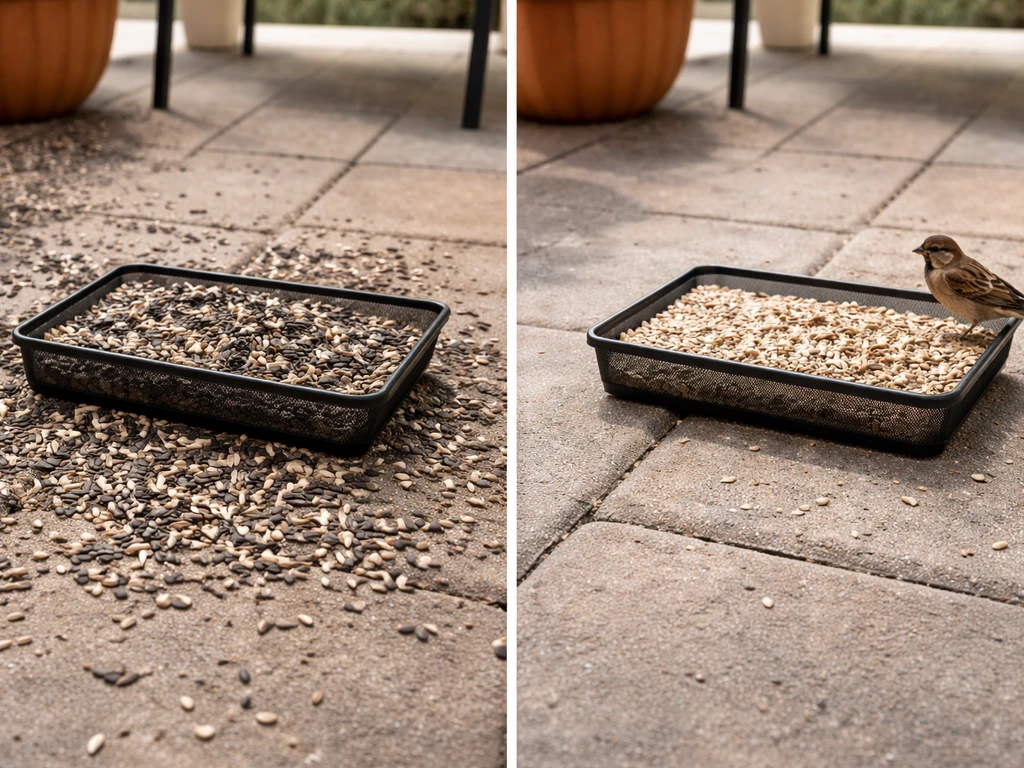
If hull removal feels like more work than you want, the simplest fix is buying pre-hulled seed or adjusting your feeder setup. Pre-hulled (also called hulled or shelled) sunflower hearts, hulled millet, and dehulled safflower are all commercially available. You pay a bit more because you're buying edible seed weight rather than shell weight, but you skip the processing entirely and dramatically reduce ground mess.
Feeder choices that reduce hull litter
- Tray or platform feeders with drainage holes let hull fragments fall through or dry quickly instead of piling up and rotting.
- Tube feeders with a hull catcher tray attached at the bottom collect dropped hulls before they hit the ground.
- Hopper feeders work well with pre-hulled seed since there's no hull waste to pack into the mechanism and cause blockages.
- Placing feeders over a hard surface (patio stone, concrete) makes ground cleanup much easier than placing them over soil or grass.
A no-mess or no-waste seed blend, which typically combines pre-hulled sunflower hearts, hulled millet, and sometimes peanut pieces, is the low-effort alternative to processing seed yourself. Every seed in the blend is edible with no shell to drop, so what birds don't eat in the feeder drops cleanly to the ground where ground-feeding birds (like doves and juncos) will clean it up.
When separation doesn't go as planned
Hull removal at home isn't always clean, and a few problems come up regularly.
| Problem | Likely cause | Fix | Prevention |
|---|---|---|---|
| Lots of hulls still in the batch | Hull cracking was too light or skip step was missed | Run through winnowing again 1-2 more passes | Apply slightly more pressure when cracking hulls initially |
| Kernels getting blown away during winnowing | Too much airflow or pouring too fast | Lower fan speed or increase pour height more gradually | Test with a small batch first to calibrate airflow |
| Kernels crushed or oily/damaged | Too much pressure when cracking | Use lighter rolling or a cracked-seed setting on the mill | Roll slowly with minimal weight; kernels should crack, not crumble |
| Clumping or sticky hulls | Moisture in seed before or during processing | Spread seed on a dry tray in sunlight; dry thoroughly before processing | Only process fully dry seed; store in low humidity below 70% RH |
| Mold appearing on processed seed | Moisture introduced during soaking or damp storage | Discard affected seed; do not add to feeders | Process dry, store in sealed airtight containers, use within 2-4 weeks |
| Pests attracted to hull piles | Hull debris left in place outdoors | Rake up and compost or bag hulls within a day or two | Place feeders over cleanable surfaces; do regular ground cleanup |
Storage, cleanup, and what to do with the hulls
Storing processed seed
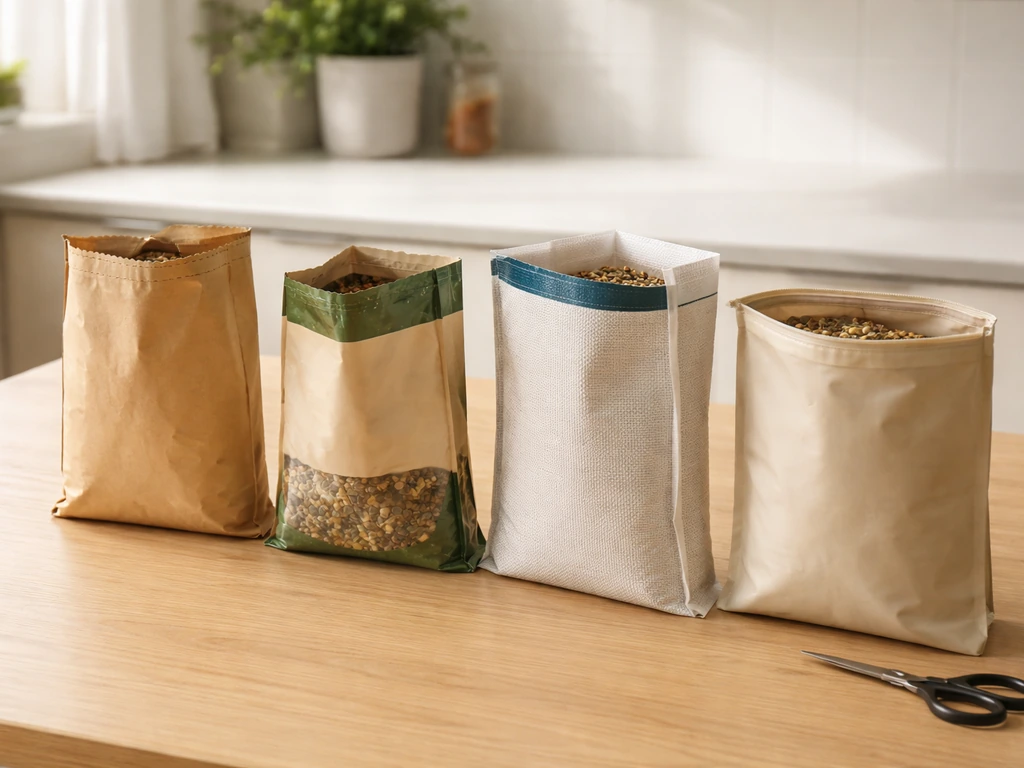
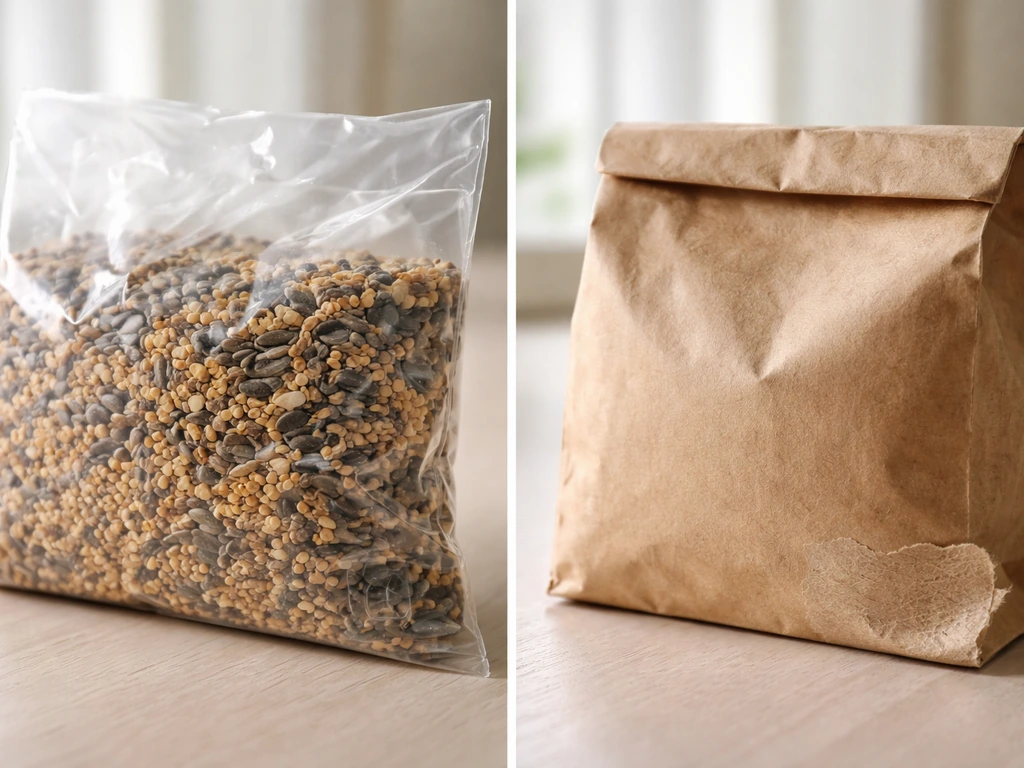
Pre-hulled or freshly dehulled seed loses its protective outer layer, which means it can go rancid or mold faster than whole seed. If you bought seed in bags, this is why opening the bag and processing it fresh matters for safe storage and the best bird-feeding results opening or processing. Store it in an airtight container (metal or thick plastic with a tight lid) in a cool, dry location. Keep relative humidity in the storage area below 70%. Processed sunflower hearts or kernels are best used within two to four weeks of opening or processing. If you smell anything rancid, off, or musty, don't put it in a feeder.
Cleaning up after processing
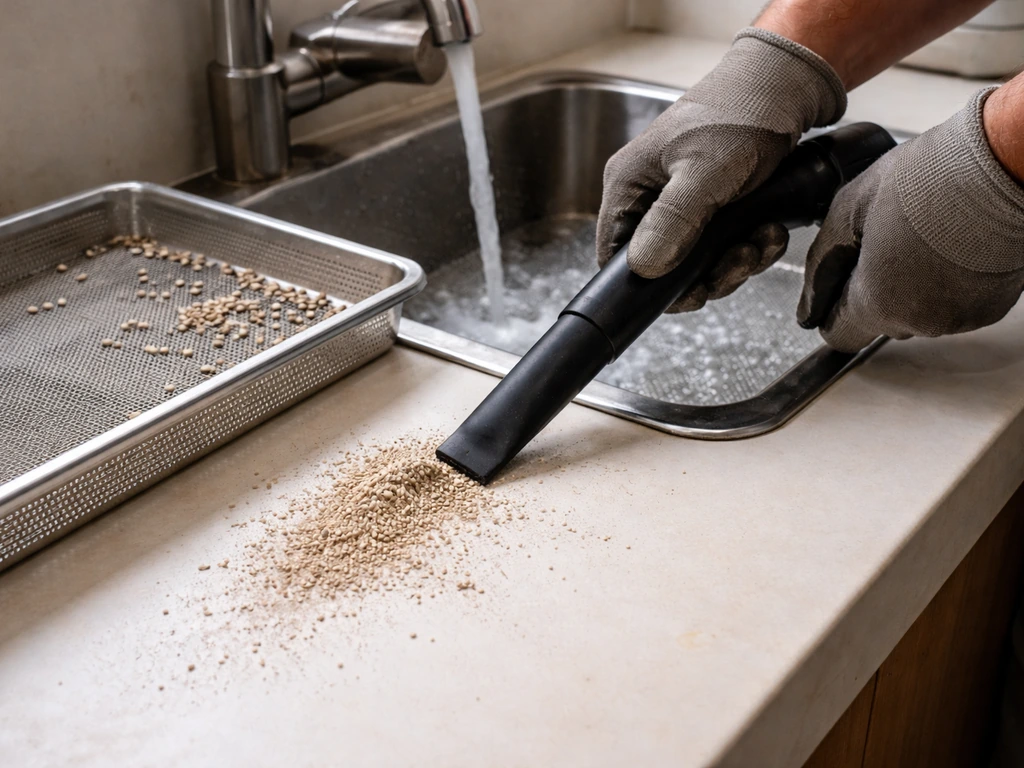
Sweep or vacuum hull dust from your work surface promptly. Hull dust can harbor mold spores and attract insects if left sitting. Wash any trays, screens, or containers you used with hot soapy water, rinse thoroughly, and let them air dry completely before the next use. If you process seed regularly, a monthly wipe-down of your storage containers and work area with a 10% bleach solution (1 part bleach to 9 parts water) is good practice, the same ratio used for cleaning bird feeders.
What to do with the leftover hulls
blank" rel="noopener noreferrer">Sunflower hulls can be composted, though they break down more slowly than soft plant material. Chop or break them up to speed decomposition and mix them well into the pile rather than letting them form a mat. Some gardeners use sunflower hulls directly as a mulch layer, though they can inhibit germination of some plants due to mild allelopathic compounds, so keep them away from seedbeds. Safflower hulls compost fine and don't carry the same concern. Millet hulls are so small they can go straight into a compost bin or yard waste bag. Not sure what to do with the leftovers? Learn whether bird seed bags are recyclable in your area.
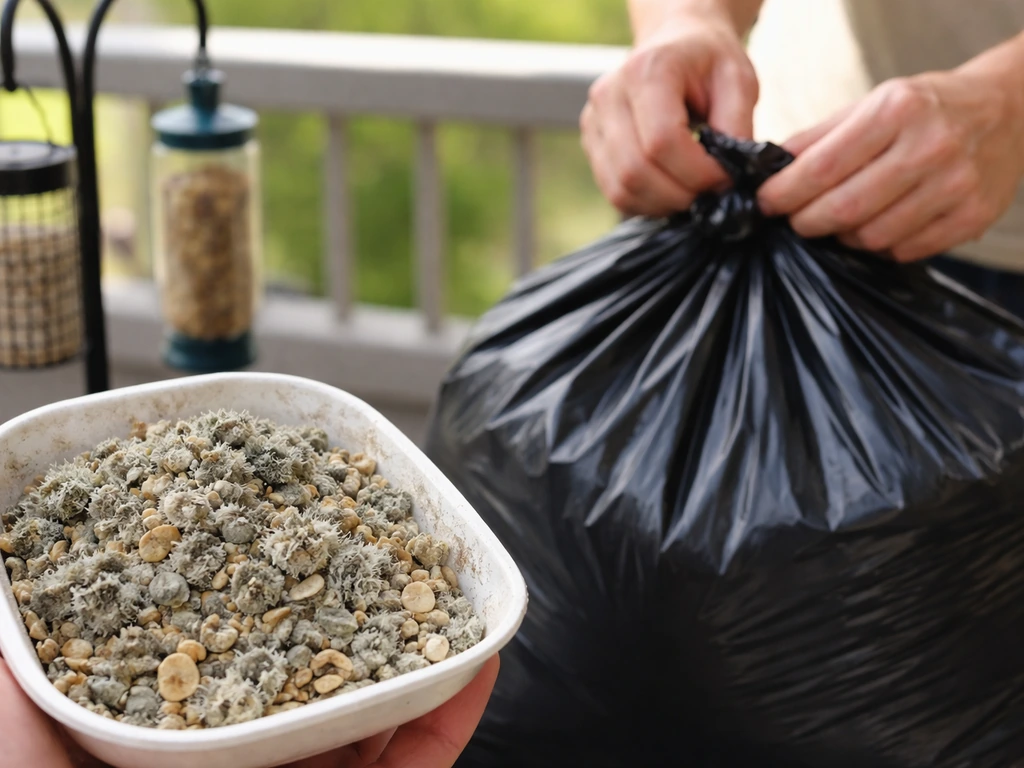
If you have a significant volume of moldy seed or hull material (not just a small amount of surface mold), bag it and put it in the trash rather than composting it, since mold spores in compost can spread. If you have leftovers, you can also compost bird seed, but avoid composting moldy seed. If you're dealing with moldy bird seed, remove it from feeders right away and dispose of it safely to protect the flock moldy seed. This connects to the broader challenge of managing spoiled seed, which is something worth knowing before it becomes a regular problem at your feeder station.
Feeder hygiene after switching to hulled seed
Because hulled seed lacks its protective shell, feeders need cleaning more often, not less. Any moisture that gets into the feeder will affect exposed kernels faster than it would whole seed. Clean your feeder at least every two weeks with a 10% bleach solution (1 part bleach to 9 parts water), scrub all surfaces, rinse thoroughly, and let it dry completely before refilling. In warm, humid weather or after rain, clean more often. A wet feeder refilled with hulled seed is the fastest way to create a mold problem that harms rather than helps the birds you're trying to feed.
FAQ
Can I use a regular kitchen sieve or colander to remove hulls?
You can, but it often won’t work well because many kitchen colanders have openings that let kernels fall through along with hull fragments. For the best results, use a screen with openings sized to retain the flatter hull pieces after cracking, and test with a small handful before processing an entire batch.
How do I know whether my screened material still has too many hulls in it for my birds?
Look for a dusty or papery, lightweight layer that collects at the bottom of the tray after you pour it into a feeder. If you see birds repeatedly picking at the shells but dropping them, or you find excessive hull buildup under the feeder within a day, run one more screen or a second winnowing pass rather than refilling.
Is there a safe way to speed up processing without increasing mold risk?
Yes. Keep everything dry and process in smaller batches so seed does not sit around damp or warm. Work in an area with good airflow, and store hulled seed right away in an airtight container instead of leaving it spread in a thick pile while you finish.
What should I do if I accidentally soaked seed and some went moldy?
Do not attempt to dehull or “rescue” visibly moldy seed for feeders. Remove it from circulation immediately, bag it for disposal if it is more than a small pinch of surface mold, and sanitize trays and screens afterward with hot soapy water followed by a bleach solution.
Will dehulled sunflower hearts spoil faster than whole sunflower seed?
Yes. Once the protective shell is removed, oils in the kernel can go rancid and moisture can trigger mold sooner. Keep hulled seed sealed in a cool, dry place, use within about a few weeks after opening, and discard any batch with off odors such as musty, rancid, or sour.
What is the best storage method for hulled seed if I can’t use it right away?
Store hulled seed in an airtight container with a tight lid, in a cool and dry location. If your storage area runs humid, consider using a desiccant container nearby, and avoid frequent opening that introduces moisture and swings in temperature.
How do I prevent hull dust from irritating my lungs and eyes while winnowing?
Use outdoors or in a well-ventilated garage, wear eye protection, and wear a mask that filters fine dust. Avoid pointing exhaust directly toward your face, and keep a tarp or tray barrier so hulls and kernels do not blow back into your work area.
How can I stop hull buildup under the feeder if I am dehulling at home?
Use a catch tray or feeder skirt that is easy to remove, and line the area under feeders with removable paper or a shallow tray you can swap quickly. Clean hulls promptly, since they trap moisture and can attract pests if left in place.
Is it worth trying to dehull safflower for small birds like finches?
Often it is not necessary unless you specifically want softer-billed birds to eat safflower. Safflower shells are thick, and untreated safflower tends to be ignored by smaller birds. If you do dehull, process only what you can use promptly because the kernels spoil faster than whole seed.
Can I compost all hulls and leftover seed?
Most dry hulls are compostable, but do not compost moldy seed or large amounts of mold-contaminated material. Bag and discard moldy portions, and for composting hulls, break them up so they do not mat and mix them well into the pile.
How often should I clean screens and tools after dehulling?
Clean them after each session if you process hulled kernels regularly, because residual dust can grow mold and attract insects. Wash with hot soapy water, rinse thoroughly, and let them fully air dry before the next use; deeper sanitizing with a diluted bleach mix is helpful if you dehull frequently.