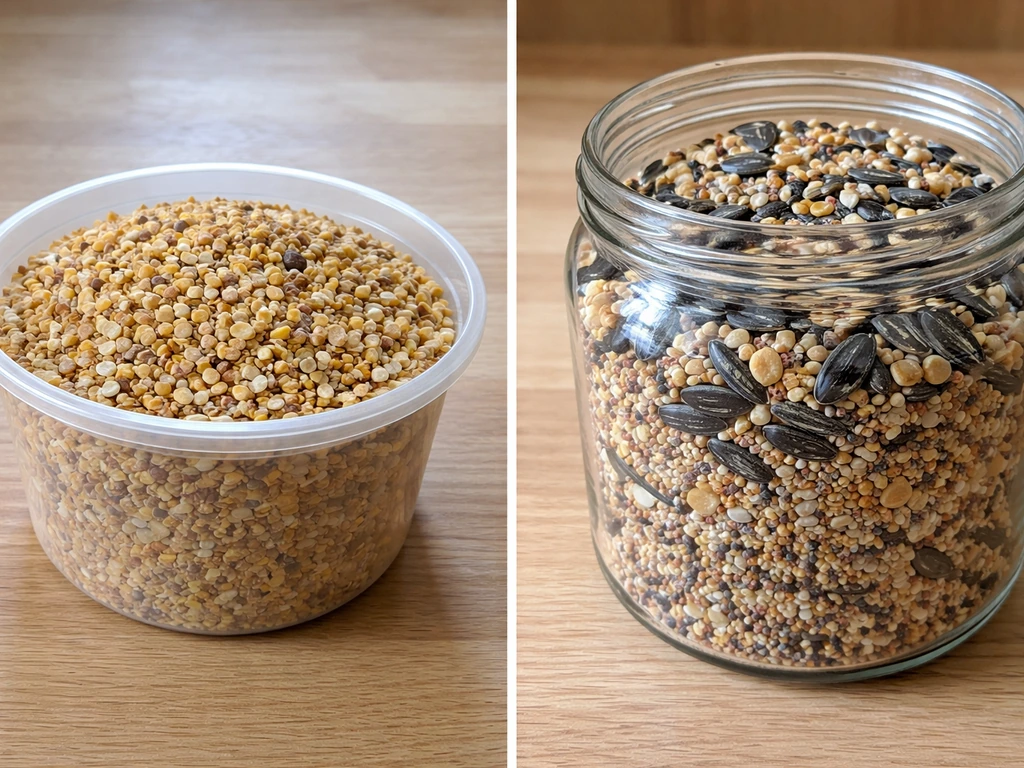
Bird seed is a mixture, not a solution. If you are deciding between seed and pellets for your bird, the best choice depends on your species and the nutrition balance of the formula seed or pellets. Specifically, it is a heterogeneous mixture: a physical blend of separate solid ingredients (sunflower seeds, millet, cracked corn, safflower, and so on) that you can see, pick apart, and separate by hand.
Is Bird Seed a Mixture or Solution? What’s in It
Maya Collins
22 Jun 2026
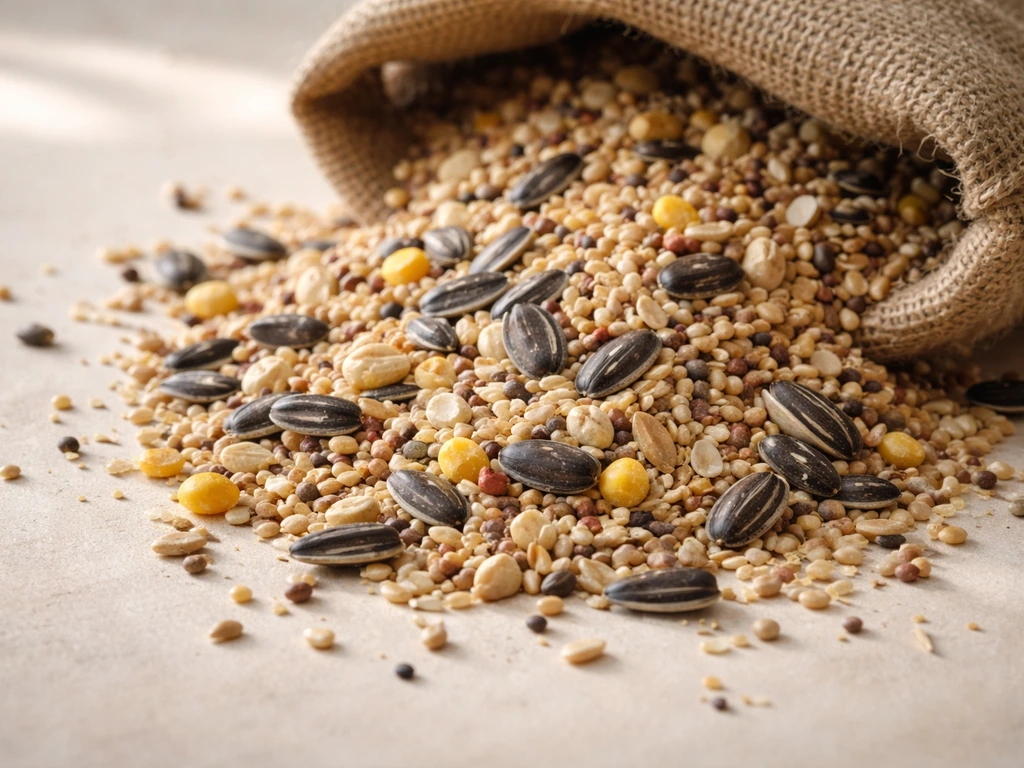
Mixtures are physical combinations of two or more substances, which can be heterogeneous or homogeneous a physical blend of separate solid ingredients. Nothing is dissolved into anything else.
If you flip the bag over and read the ingredient list, you will find a lineup of distinct seeds and grains listed one after another, which is exactly what a heterogeneous mixture looks like on a label.
Mixture vs. solution: what the terms actually mean
A mixture is any physical combination of two or more substances. The substances keep their own identities and can, at least in principle, be separated back out. blank" rel="noopener noreferrer">A solution is a specific type of mixture where one substance (the solute) dissolves completely into another (the solvent), creating a uniform result with no visible separate pieces. Salt water is a solution. Hummingbird nectar, made by dissolving one part sugar into four parts water, is also a solution.
Mixtures split further into two categories. A homogeneous mixture looks the same throughout, like that sugar-water nectar. A heterogeneous mixture is not uniform: you can see and pick out the individual parts. A bag of wild bird seed with visible sunflower seeds, millet, and corn is the textbook definition of a heterogeneous mixture. The components are not evenly blended at a molecular level, and they will separate on their own if you shake the bag or pour from it.
What a solution would look like in bird feeding (and why seed usually isn't one)
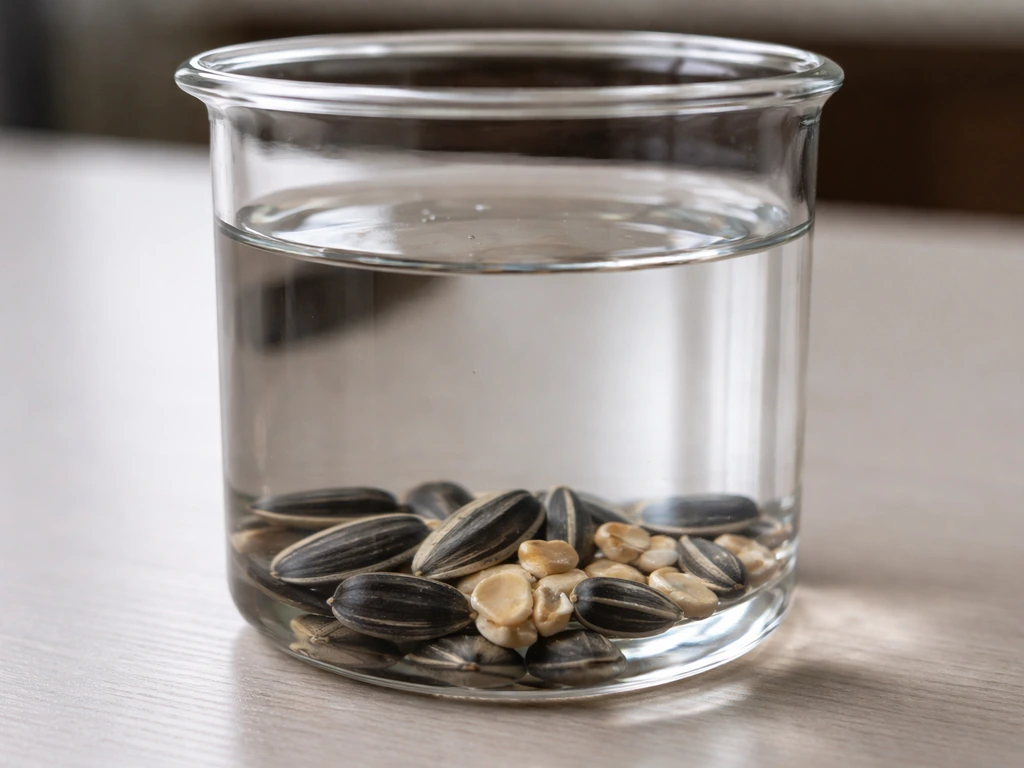
For bird seed to be a solution, the seeds would have to dissolve into a liquid solvent until no distinct particles remained. That simply does not happen with whole or cracked seeds. The only bird foods that genuinely qualify as solutions are liquid ones: hummingbird nectar (sugar dissolved in water) and any water-based bird "slurry" or gel product where a powder is fully dissolved into a liquid. Standard feeder seed, suet cakes, and pellets are all solids with visible components, so none of them are solutions.
This distinction matters practically. Because nectar is a true solution, it behaves differently in your feeder: it can ferment, go cloudy, or grow bacteria in the liquid itself. Extension guidelines recommend replacing hummingbird nectar every 3 to 5 days and cleaning the feeder before each refill. Solid seed mixtures spoil differently, through moisture-driven mold and sprouting rather than liquid fermentation, which changes how you store and handle them.
Common bird seed types and how to classify each
Not everything sold as "bird food" is the same kind of product, so it helps to know what category each type falls into before you worry about storage or handling.
| Product type | Examples | Classification | Why |
|---|---|---|---|
| Loose seed blend | Black oil sunflower, white millet, cracked corn, safflower mix | Heterogeneous mixture | Visible solid components that can be sorted or separated by hand |
| Single-seed product | Pure black oil sunflower, pure nyjer (thistle) | Pure substance or simple mixture | One seed type; still a solid, not dissolved |
| Compressed seed cake/block | Seed and millet pressed into a cage-ready block | Heterogeneous mixture | Solid ingredients bound together but still physically distinct |
| Pellets or nuggets | Extruded or ground meal pellets (e.g., bird pellets) | Homogeneous mixture or processed blend | Ingredients are ground and combined uniformly, but still solid |
| Suet cake | Rendered fat with seed, fruit, or insects pressed in | Heterogeneous mixture | Fat is a carrier, not a solvent; solid inclusions remain distinct |
| Hummingbird nectar | Sugar dissolved in water (1:4 ratio) | True solution (homogeneous mixture) | Solute fully dissolves into solvent; no visible particles |
| Liquid or gel bird food | Water-based gel feeders, fruit-flavored liquid feeders | Solution or suspension | Uniform liquid or near-uniform; no bulk solid particles |
If you are comparing suet to seed or thinking about pellets versus seed as dietary options, those are genuinely different products with different compositions, but they are all still mixtures rather than solutions. Bird pellets versus seed differ in how they’re formulated, which affects how they interact with moisture and spoil over time. The liquid products stand alone as the only true solutions in a typical backyard feeding setup.
How to read a label and identify what you have
Flip the bag or container over and find the ingredient list. Here is what each type looks like:
- Heterogeneous seed mixture: You will see a list of named seeds and grains separated by commas, like "White Millet, Black Oil Sunflower Seeds, Cracked Corn, Safflower Seed, Red Millet." Each one is a separate solid that you can see in the bag.
- Pellets or processed meal blend: Ingredients may include ground grains, vitamins, and minerals listed in order by weight. The product looks uniform because it has been processed, but it is still a solid blend.
- Suet or fat-based block: Ingredient lists typically lead with rendered beef fat or a fat source, followed by seeds, nuts, fruit, or insects as inclusions.
- Nectar or liquid feeder product: Ingredients are a sugar source and water, sometimes with coloring. If it is sold as a ready-made liquid, it is a solution.
- Additive-enhanced blends: Some seed bags add vitamins or flavor coatings. The base product is still a heterogeneous solid mixture even with these additions.
If you can pick out individual pieces by eye in the product, it is a heterogeneous mixture. If the product is a uniform liquid with no floating particles, it is likely a solution. Everything in between, like pressed seed cakes, sits firmly in "mixture" territory.
What being a mixture means for sorting, separation, and freshness
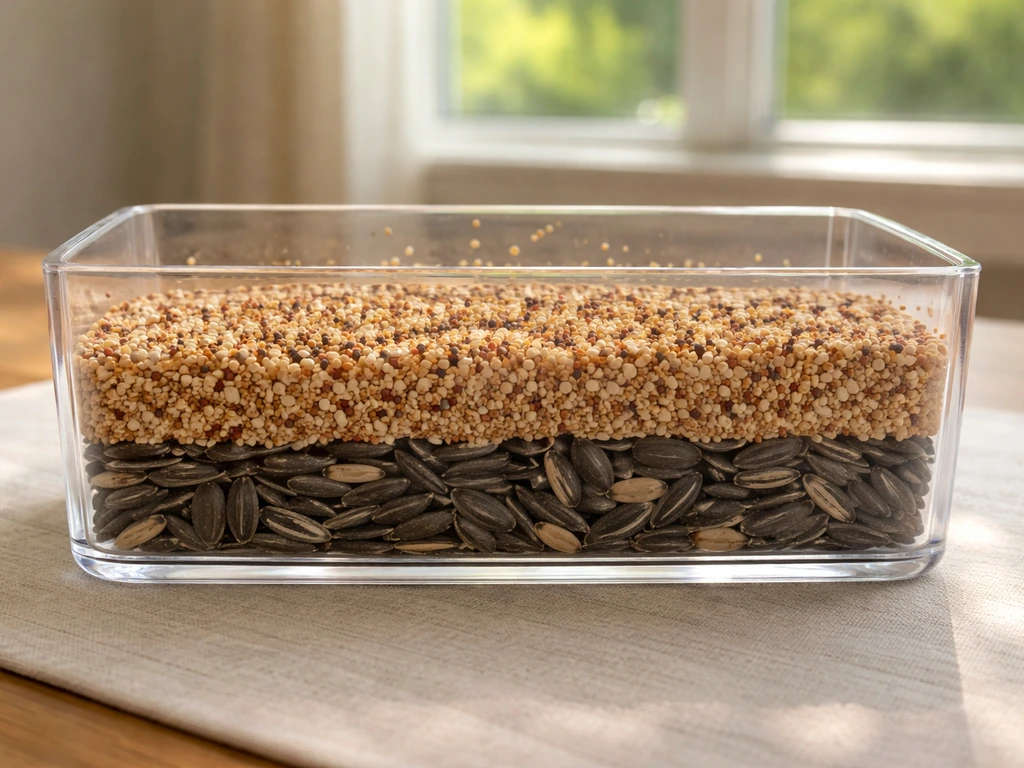
Because bird seed is a heterogeneous mixture, its components naturally separate. Heavier seeds like sunflower sink to the bottom of a bag or feeder; lighter seeds like millet rise to the top. You may notice certain birds picking out only one type and flicking the rest to the ground. This is mixture behavior in action: the parts were never chemically bonded, so birds (and gravity) can separate them with ease.
Freshness also varies by component. Some seeds in a blend go rancid faster than others. Oils in sunflower seeds and peanuts degrade more quickly than millet or corn, especially in warm weather. Because the components stay physically distinct, you can sometimes smell one type going off while others are still fine. If a blend smells rancid or musty even before you see mold, trust your nose: one of the components has turned.
Practical tip: buy seed in quantities your birds can finish within two to four weeks in warm months, or four to six weeks in cool, dry conditions. Extension guidance recommends offering only as much loose seed as birds can consume in a day on open platform feeders, precisely because leftover exposed solid mixture can go stale or wet overnight.
Storage and moisture: wet seed, sprouting, and mold prevention
Moisture is the main enemy of a solid seed mixture. Because the components are not dissolved in anything, they cannot "protect" themselves chemically the way an acidic solution might. Water introduced into a seed blend creates ideal conditions for blank" rel="noopener noreferrer">mold (including Aspergillus, which causes aspergillosis in birds) and can trigger germination, turning your feeder into a sprouting tray. If you are deciding between different feed formats, it helps to compare suet vs bird seed too, since suet is handled differently and typically avoids the same wet-seed sprouting problems. Both outcomes are hazardous to the birds visiting your yard.
Storage rules that actually work
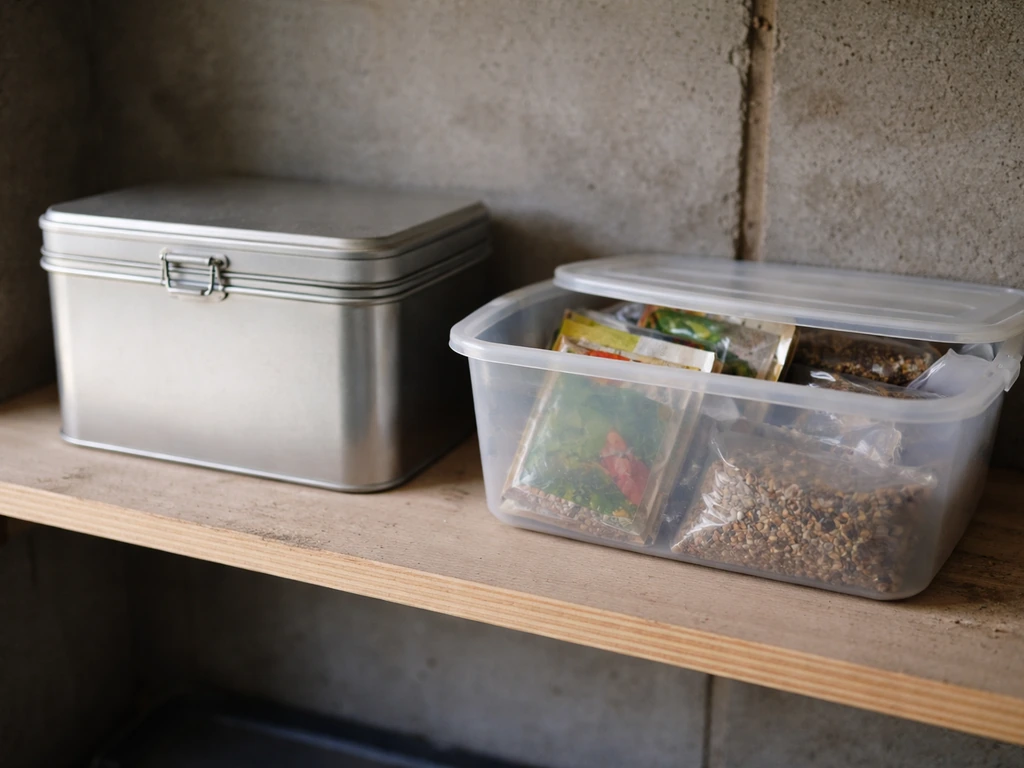
- Keep seed in a sealed, hard-sided container (metal or thick plastic with a tight-fitting lid) to block moisture and rodents.
- Store in a cool, dry location: a garage or shed works better than outdoors in summer heat or rain.
- Do not pour new seed on top of old seed in the same container. Use the old seed first, then clean and dry the container before adding a fresh batch.
- Check seed monthly by smell and sight. Clumping, a sour or musty odor, visible mold, or webbing are all signs to discard.
What to do with wet or sprouting seed
If seed in a feeder gets rained on or develops clumps, remove it promptly. Do not let it dry out and reuse it: once moisture has penetrated, mold spores may already be present even if you cannot see growth yet. Extension guidance from Penn State and others is direct on this: if seed is moldy, do not use it. Dispose of wet or clumped seed in a sealed bag in the trash, not in a compost pile where birds or rodents might still access it.
Pests, hygiene, and safe cleanup when seed goes bad
Because bird seed is a loose physical mixture, it produces physical waste: hulls, dust, and uneaten pieces that fall to the ground under feeders. That accumulation draws insects, rodents, and disease. Treating it like a static product that just sits there is a mistake. It needs active management.
Preventing pests in the first place
- Rake or sweep the ground under feeders at least once a week to remove hulls, droppings, and fallen seed.
- Use feeders with trays to catch debris and reduce ground scatter.
- Switch to no-waste mixes (hulled sunflower, shelled peanuts) if ground mess and rodent activity are major problems.
- Store seed containers away from the feeder area so spills near the feeder don't attract rodents to a larger food source.
Cleaning a contaminated feeder
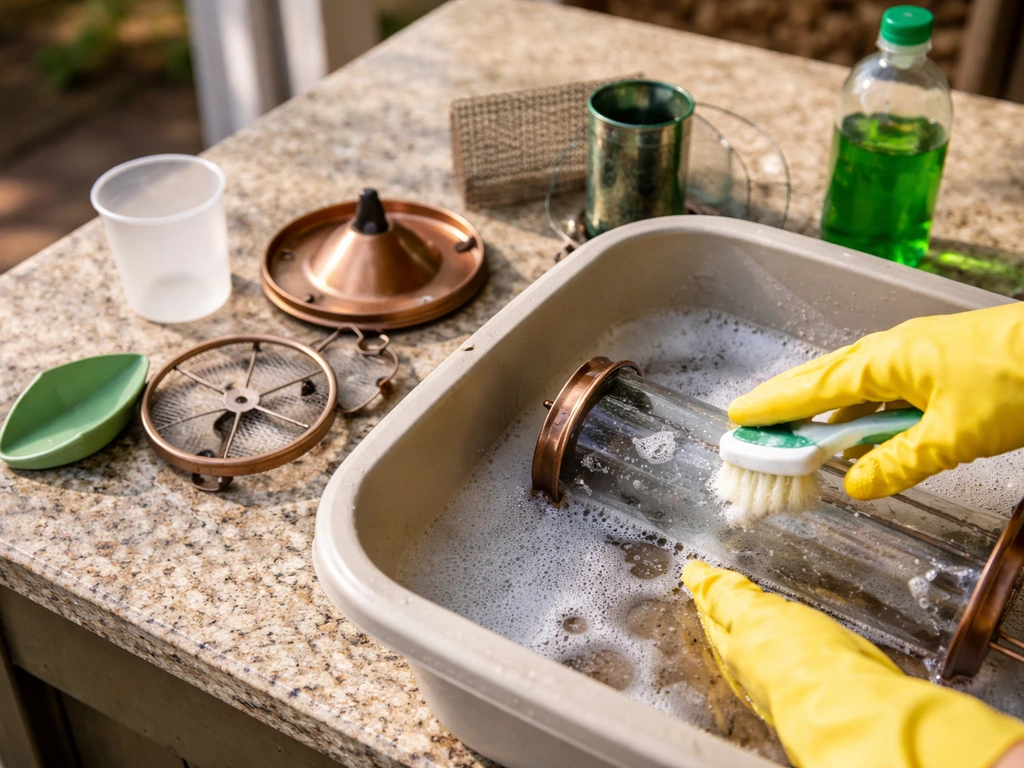
If you find mold, dead birds near the feeder, or signs of a disease outbreak, take the feeder down immediately. Empty all remaining seed and dispose of it in sealed trash. Then clean the feeder using this standard protocol:
- Wash the feeder with dish soap and hot water, scrubbing out all residue.
- Prepare a 10% bleach solution: 1 part household bleach to 9 parts water.
- Submerge or thoroughly coat the feeder in the bleach solution and let it soak for 15 minutes.
- Rinse thoroughly with clean water until no bleach smell remains.
- Allow the feeder to air dry completely before refilling. Do not add fresh seed to a damp feeder.
Monthly cleaning with the same 10% bleach solution is a good baseline even when nothing looks wrong. Iowa DNR and multiple extension services recommend this schedule as routine maintenance, not just a response to visible contamination.
Signs seed has gone bad and needs to be discarded
- Visible mold: fuzzy growth of any color on seed or inside the feeder
- Clumping: seed that has stuck together in masses rather than flowing freely
- Rancid or sour smell: an oily, off smell rather than a neutral or nutty one
- Webbing or insects: moth larvae, weevils, or other insects inside stored seed
- Sprouting: seeds that have started to germinate, especially in the feeder itself
Any of these signs means the mixture has been compromised. Discard it fully, clean everything the seed touched, and start fresh with dry, properly stored seed. The mixture classification that makes bird seed easy to sort and serve is the same reason it needs careful handling: those separate solid components respond individually to moisture, heat, and time, and there is no liquid medium protecting or preserving them.
FAQ
If I add water to bird seed, does it become a solution?
Mostly, but it depends on the product form. Traditional loose seed blends and cracked grain mixes are heterogeneous mixtures. Products like fully dissolved “nectar” concentrates (where powder or syrup is dissolved into water) behave like solutions only after you add water and stir until no particles remain.
What about “seed water” or soaking bird seed in a bowl, is that a solution?
No. Mixing seed with water makes a suspension at best, because the solid particles do not dissolve. The liquid may still change color or smell from oils and juices, but you can usually see floating or settling solids.
Are packaged hummingbird “nectar” mixes always solutions?
Check the ingredient list for wording like “sugar dissolved in water” or “prepared nectar.” Many packages marketed as nectar are actually powders, syrups, or concentrates you dissolve before serving, and the diluted version is the solution. The dry powder itself is not a solution until it is dissolved.
How can I tell at home whether a bird drink is a solution or just cloudy?
Look for physical uniformity, not just “it came in a bottle.” If you can see separation, particles, or sediment after shaking, it is not behaving like a true solution. True solutions should stay uniform without floating pieces.
Are pellets or suet solutions since they are manufactured into a single shape?
Yes. Pellets and suet are still mixtures because they are formed from distinct components pressed together. They do not turn into a uniform molecular blend, and moisture issues differ from nectar because the pellet remains a solid phase.
Can a bird seed blend look uniform in the bag but still be a heterogeneous mixture?
Watch how the product behaves when poured. Loose seed mixes often separate quickly with settling, and some feeders can make heavier seeds dominate. Even if blends look evenly mixed in the bag, gravity and handling can cause uneven distribution.
If my seed gets a little damp, can I dry it and keep using it?
Yes, but it helps to be precise. If you notice clumping, wet streaks, or any visible mold, treat it as contaminated and discard it rather than trying to “dry it out.” Once moisture has penetrated, mold may already be established even if it is not obvious yet.
What storage step matters most for a seed mixture after opening?
Consider storage format. Storing seed in sealed, moisture-resistant containers helps slow mold and rancidity, especially once the bag is opened. Also separate particularly oily components (like sunflower) if your blend allows it, since those typically go rancid faster.
Why does leaving seed out longer increase problems if bird seed is “just a mixture”?
Yes. On platform feeders, leftover solid seed is exposed to overnight humidity, which increases mold and sprouting risk. A common mistake is leaving large piles continuously, which gives moisture time to penetrate deeper into the mixture.
What is a quick checklist I can use when buying a new “bird food” product?
Use the “ingredient list and label” method. If the label lists multiple intact seeds or grains, it is a heterogeneous mixture. If it lists only solutes in a liquid preparation and you see no particles, it is likely a solution. When in doubt, assume mixture behavior for solids and handle accordingly.
Next Article
Chicken Scratch vs Bird Seed: Differences and Safe Use
Compare chicken scratch vs bird seed, contents, target birds, pest risks, and safe storage, feeding, and cleanup tips.